Understand mixed information
Read structured fields and ordinary language across authorized CAD text, narratives, forms, policies, and locally approved reference material.
AI-assisted public safety · independent early-stage initiative
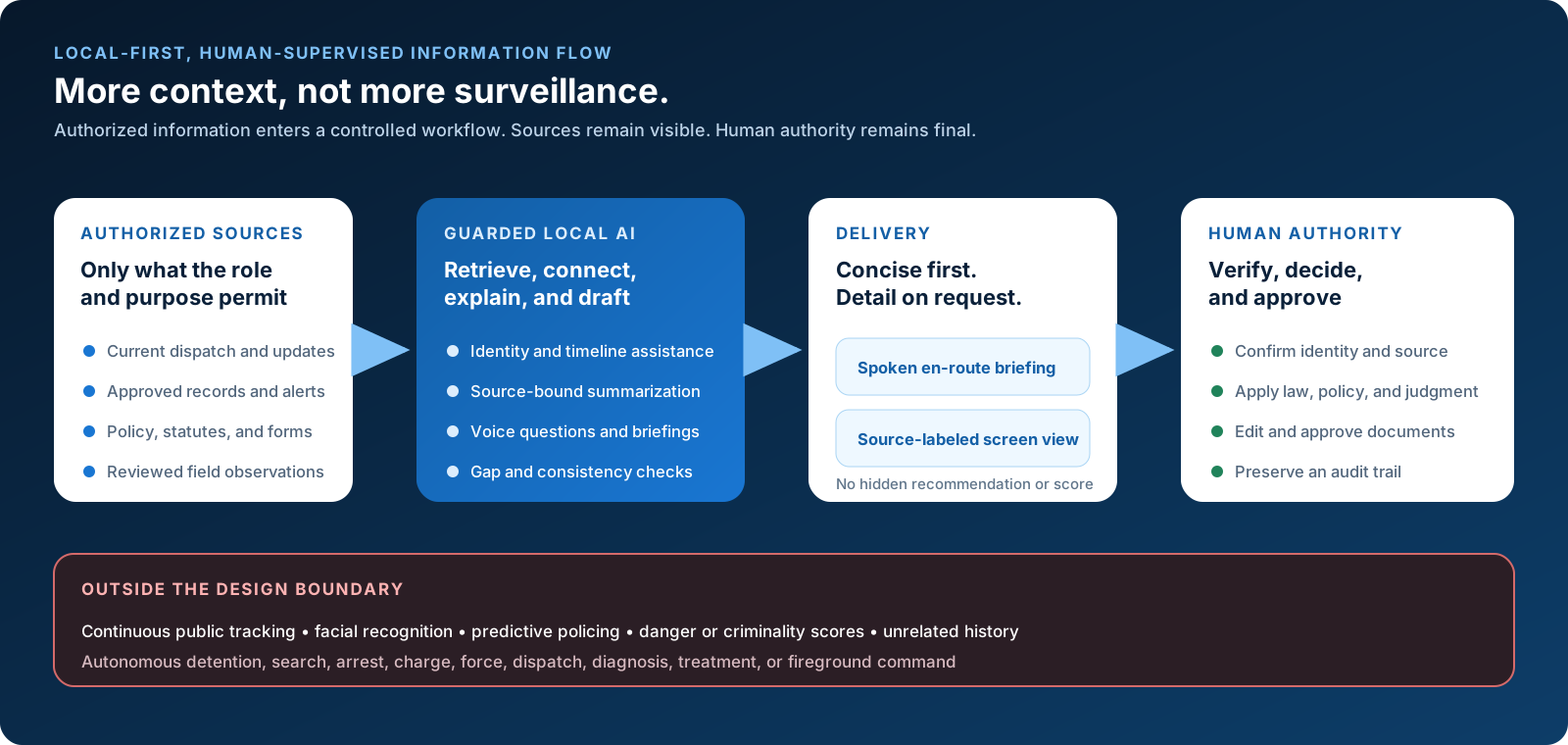
The First Responder Local AI Initiative is building a local-first, human-supervised system that can gather authorized information from fragmented sources, connect what matters to the current incident, preserve each source and status, and deliver a concise voice-and-screen briefing while the responder is en route.
Law enforcement first, with a roadmap for fire, EMS, dispatch, and emergency management.
Why artificial intelligence matters
Public-safety information lives in dispatch text, records, narratives, court documents, maps, policy, statutes, forms, evidence notes, and the memory of other responders. A conventional dashboard can display fields. AI can help interpret language, connect relevant records, answer a focused question, and explain why an item matters—without hiding the source or replacing the person responsible for the decision.
Read structured fields and ordinary language across authorized CAD text, narratives, forms, policies, and locally approved reference material.
Identify that a person, address, vehicle, date, incident, or condition may be related—then present the connection for verification rather than silently scoring it.
Return a concise answer with the originating system, date, record type, current status, and an explanation of why the item appeared.
Support short, driving-conscious voice exchanges: brief the call, answer a follow-up, repeat a warning, or expose the source when asked.
Turn reviewed notes into editable drafts, flag missing required facts, compare internal consistency, and keep the user in control before official use.
Use local speech, retrieval, and models where practical; disclose uncertainty; preserve unknowns; and degrade safely when a source or network is unavailable.
The operational safety gap
A routine return may answer the narrow query that was run while failing to expose incident-relevant context stored somewhere else. Missing that connection can affect responder preparation, victim protection, and public safety. The goal is not broader surveillance. The goal is to find the authorized, current, minimum-necessary information that a trained responder would reasonably need for the call in front of them.
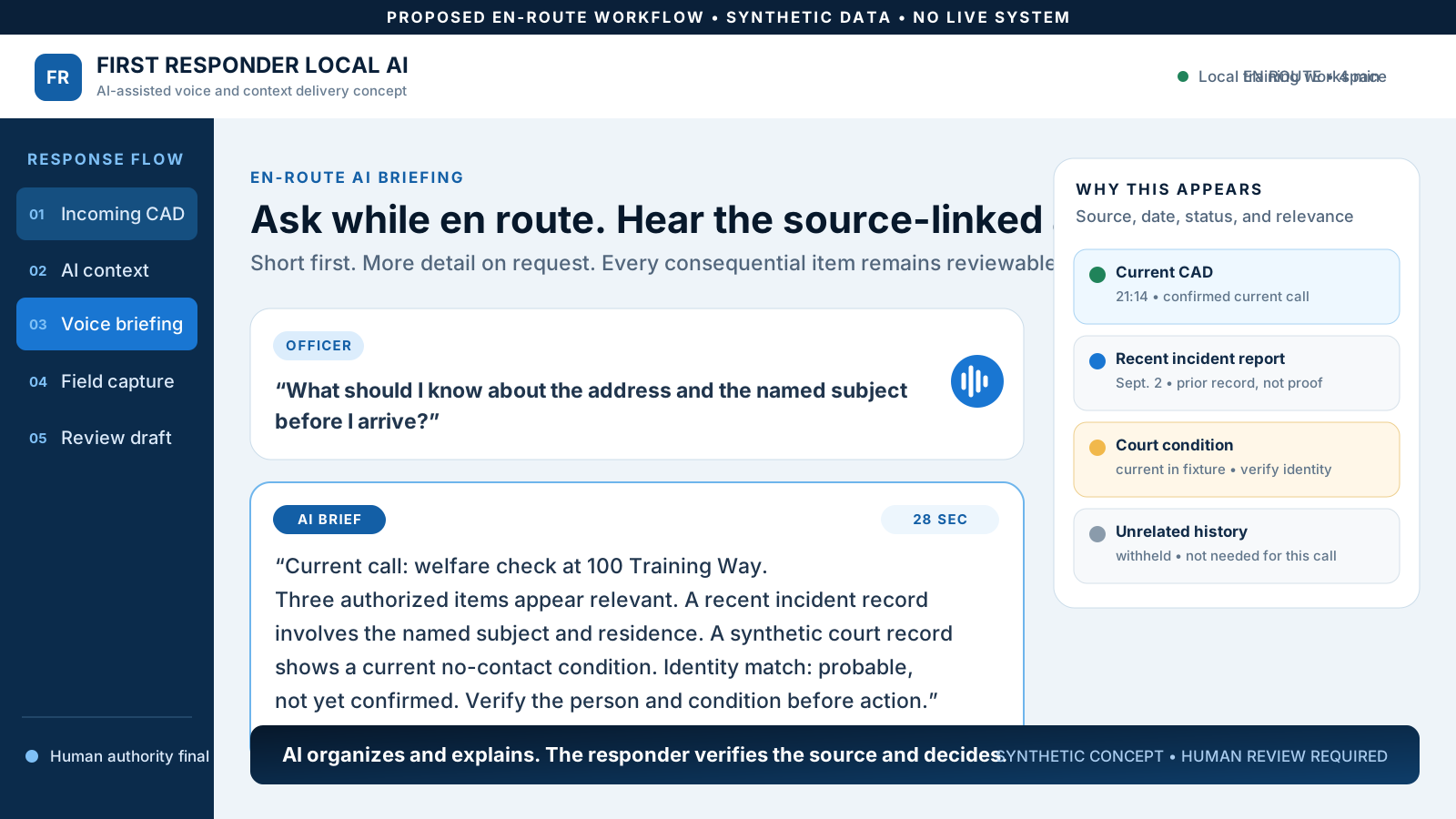
A driver says he is headed to his spouse’s residence. A normal identity or license return may not show that a separate, authorized record contains a very recent domestic-violence case and a current court or release condition connected to the same person and address.
The system would not decide that a violation occurred, treat an arrest as proof, or order detention. Under an approved integration, it could surface the source, date, record type, and status; read a concise alert; and ask the officer to verify the record before deciding what to do.
En-route voice and AI delivery
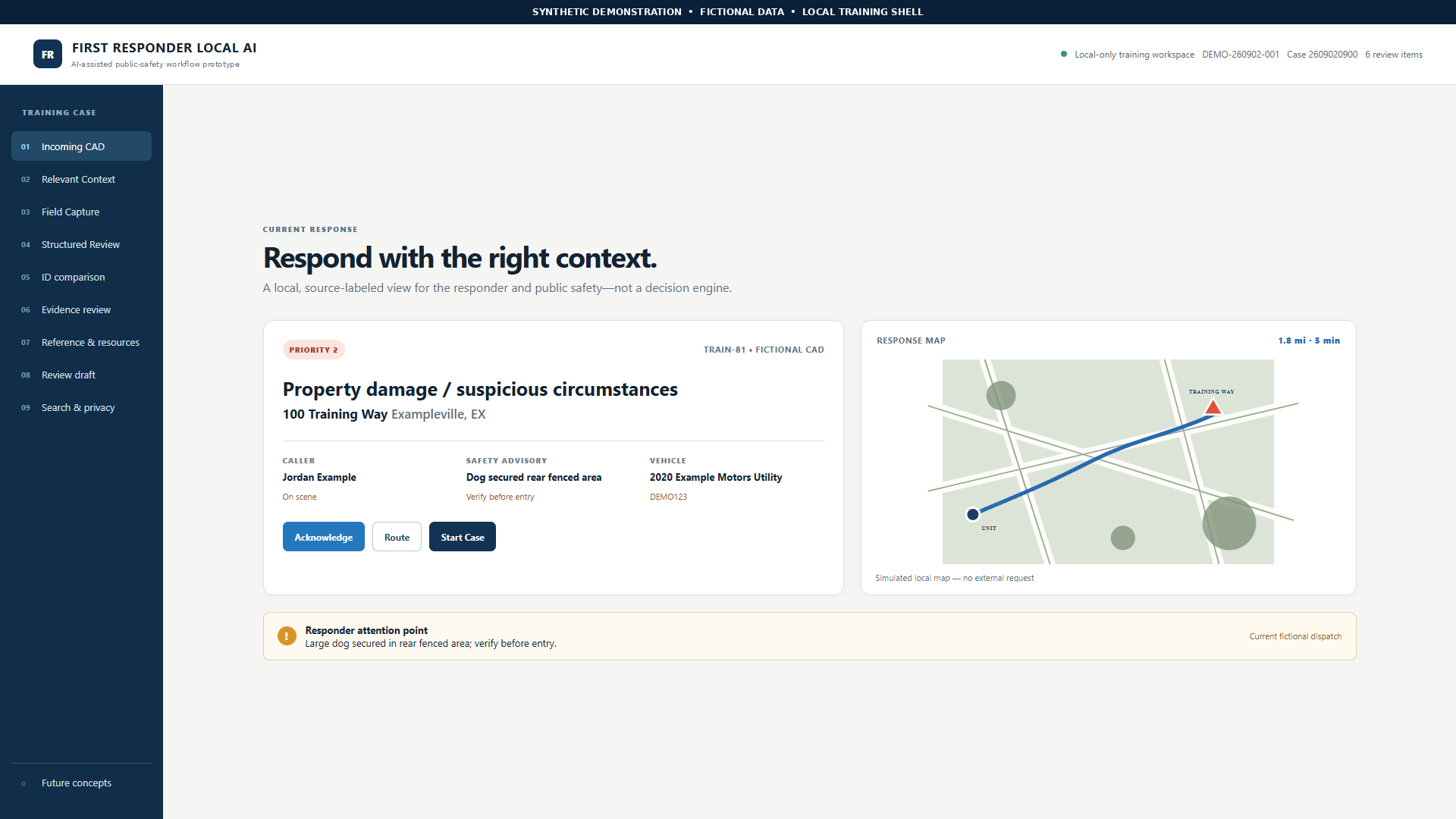
The intended patrol workflow is conversational. The responder should be able to ask a focused question in ordinary language and receive a short, prioritized, source-linked answer through the vehicle audio path—without navigating a stack of screens while moving.
Voice interaction, approved source connectors, and local-model performance remain active development work. The visual shown here is a fictional workflow concept, not a live agency interface.
The private Windows prototype
The public-facing name remains First Responder Local AI Initiative. The law-enforcement application is not being presented under its internal development codename. The current demonstration uses only fictional fixtures, and live agency connections are disabled.
Inside the working prototype
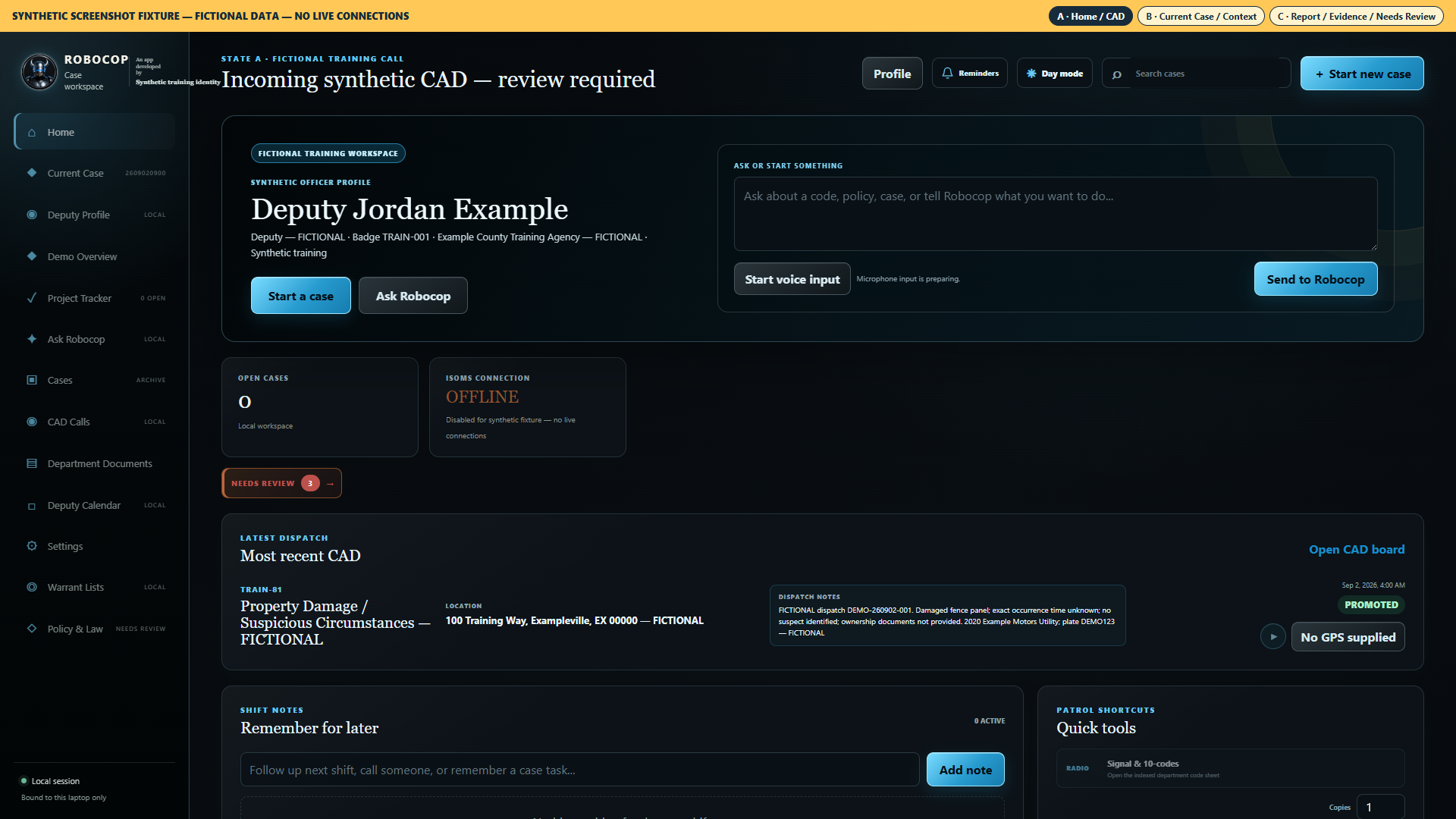
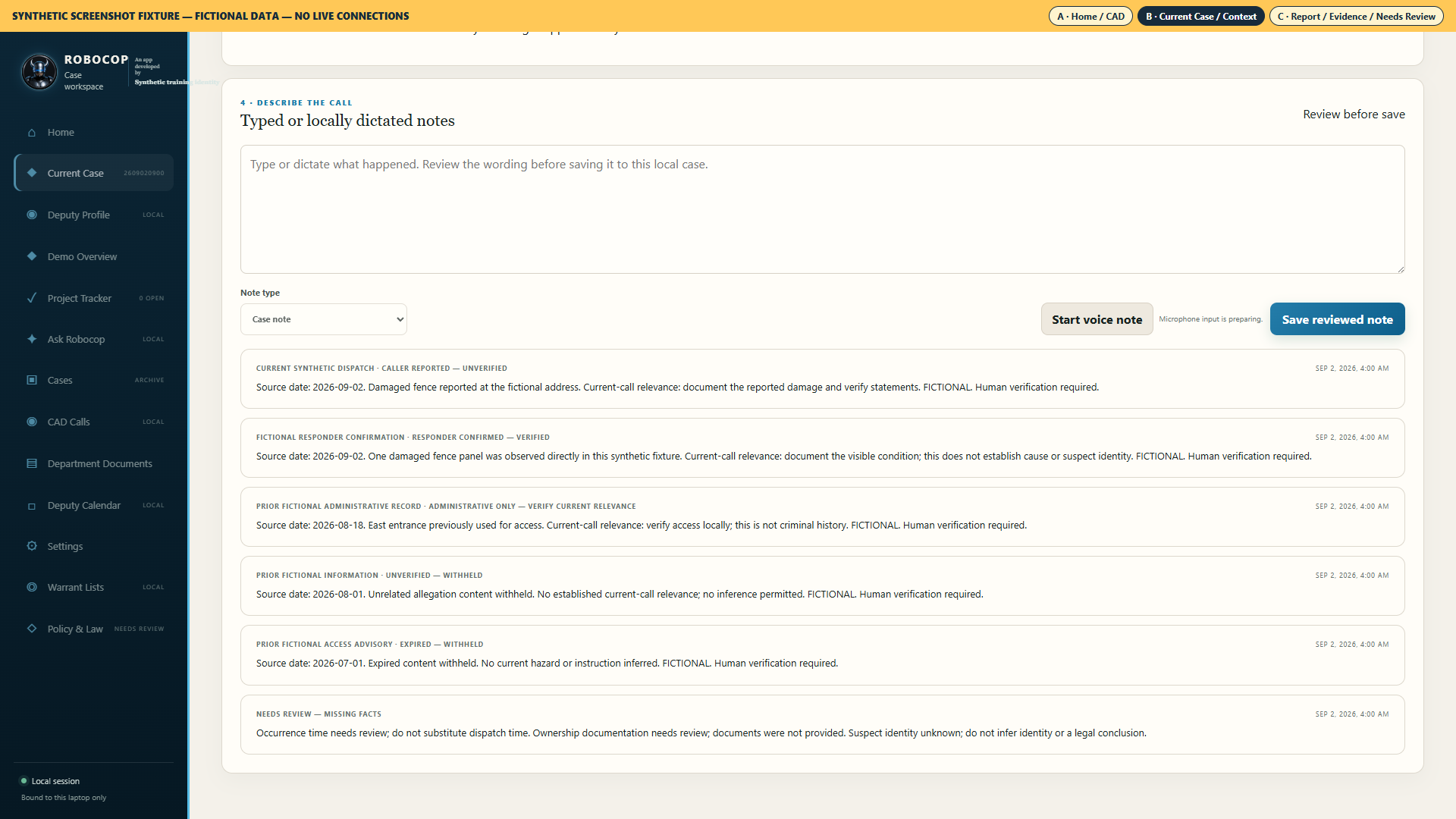
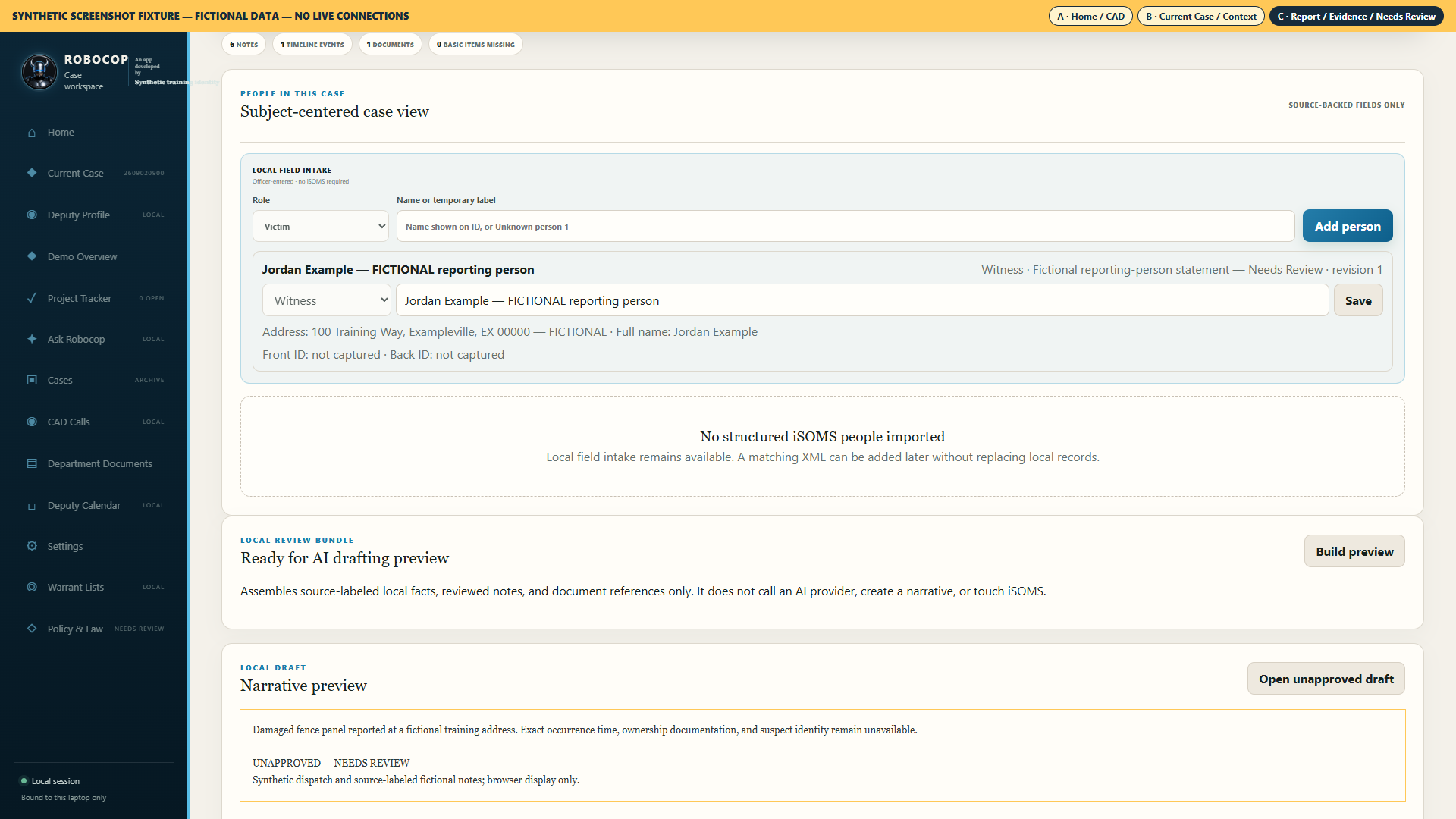
These are authentic 1920×1080 browser renders from the current officer-facing development interface. The fixture is isolated, all visible records are fictional, live connectors are denied, and no post-processing was used.
Development partnership
The initiative is seeking milestone-based support including local-AI compute, GPUs and workstations, edge systems, development hardware, storage and networking, cloud and software credits, technical guidance, architecture review, and responsible research or pilot introductions.
Support does not guarantee agency access, operational data, endorsement, procurement, exclusivity, or a pilot.One first-response mission
Each discipline requires its own rules, approved sources, specialist review, data boundaries, and validation. The shared opportunity is faster access to the right information, clearer handoffs, less repetitive documentation, and better continuity from dispatch through after-action work.
Incident context, voice briefing, field capture, legal and policy retrieval, evidence organization, report and affidavit drafting, and supervisory completeness review.
Dispatch and hazard summaries, pre-incident plans, access points, hydrants and water sources, approved procedure retrieval, accountability support, and command logs.
Approved protocol retrieval, structured scene capture, medication and procedure checklists, transport handoff, missing-information checks, and patient-care-report drafting under qualified oversight.
Call summaries, responder information packets, resource status, mutual-aid references, severe-weather and disaster checklists, and structured situation reports.
Local-first and civil-liberties guardrails
The initiative is designed to organize incident-specific, authorized, minimum-necessary information for a trained responder. It is not intended to expand collection simply because technology makes collection possible.
Development partnerships
This is not a request for general-purpose lab upgrades. Each resource should remove a verified bottleneck and produce a documented result that a technical partner can evaluate.
Measure source faithfulness, answer quality, hallucination and uncertainty handling, latency, VRAM, RAM, and offline behavior across appropriate models and quantizations.
Measure local speech recognition, retrieval, answer generation, speech synthesis, interruption, repeat behavior, noise tolerance, and safe failure under network loss.
Compare time, completeness, unsupported claims, omitted required facts, and edit burden between a manual synthetic workflow and a human-reviewed AI-assisted workflow.
Test startup time, concurrency, thermal and power limits, secure synchronization, remote administration, storage, audit, and recoverability on practical edge and server hardware.
Developer access, engineering guidance, credits, discounts, previous-generation equipment, refurbished systems, samples, evaluation units, time-limited loaners, or donated hardware may all be appropriate when the recipient, terms, test plan, and measurable milestone are clear.
Current status
Founder story
Odin Aesir spent close to a decade in network engineering and network design and now works in law enforcement. While in college, he supported IT administration for a small law-enforcement department and saw how technical analysis could contribute to investigations that affected children’s lives. After becoming burned out in the technology field, he chose a public-safety career and continued through corrections and patrol.
He now combines current law-enforcement experience with the networking, systems, and AI skills developed earlier in life. The initiative grew from a repeated field observation: important information often exists, but it is fragmented, difficult to connect while moving, and costly to reconstruct after the call. Modern AI creates a credible path to organize that information, explain it with sources, support voice interaction, and reduce administrative burden without removing trained humans from authority.
This is an independent project. Personal experience informs the problem definition, but no agency endorsement, purchase, deployment, access, or official position is implied.
Contact
Technical guidance, AI and developer programs, evaluation equipment, startup support, research collaboration, and responsible pilot introductions are welcome. No support guarantees agency access, operational data, a pilot, a government purchase, endorsement, exclusivity, or product control.